Most London venues were built for music, or at least for an audience. The Roundhouse on Chalk Farm Road in Camden was built for steam locomotives. It was out of date within a generation, spent around half a century full of gin, and only then became one of the most storied rooms in British music. It is round because of what it was designed to hold: a railway turntable.
Built to turn engines
The building went up in 1846–47 as a goods locomotive shed on the railway out of London to Birmingham. Historic England's listing credits the design to Robert B. Dockray and the construction to Branson & Gwyther; the Guardian and Wikipedia also credit the railway pioneer Robert Stephenson. In its first years it was known as the Great Circular Engine House, or the Luggage Engine House.
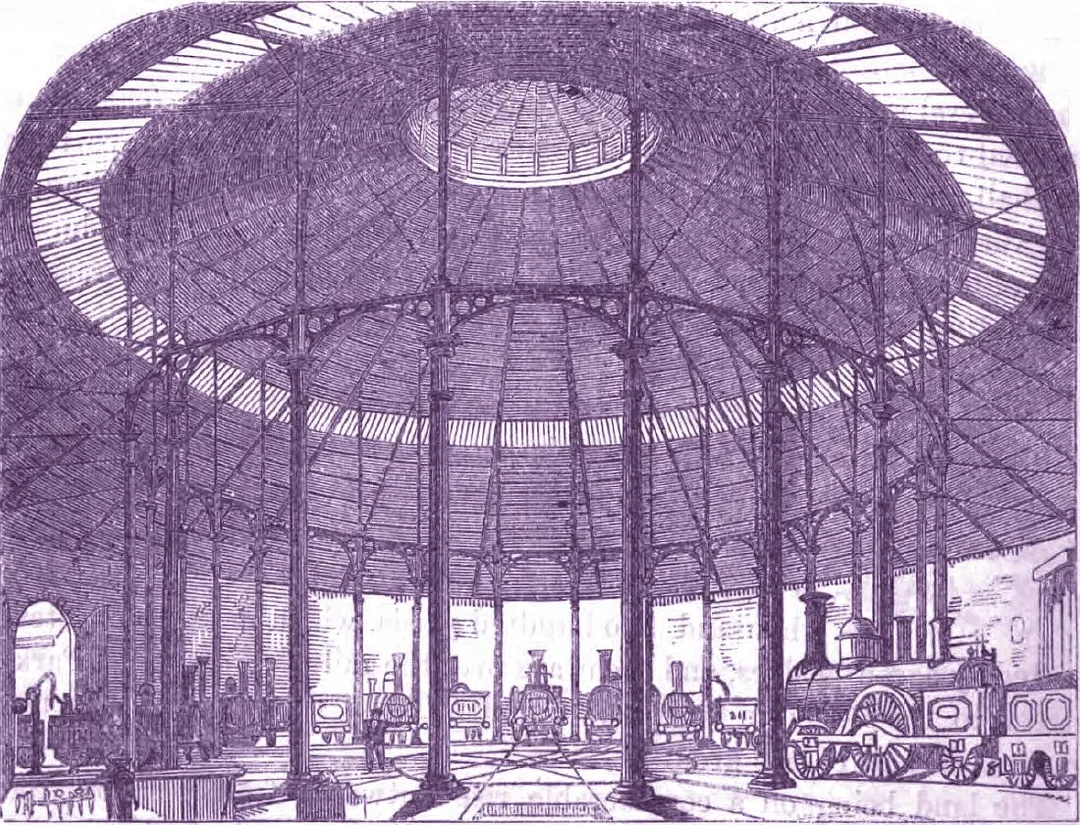
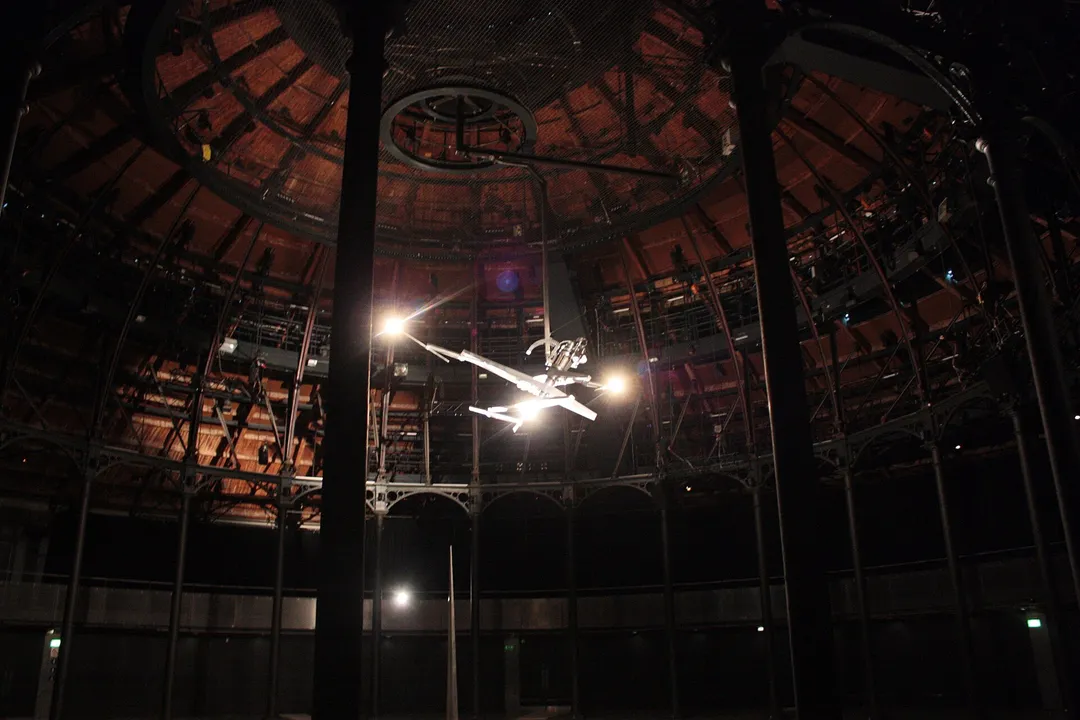
The idea was simple. A locomotive rolled in, a turntable at the centre swung it round, and it was parked on one of the tracks that radiated outwards like spokes. The plan is a circle 48 metres across, built of yellow stock brick, under a low conical slate roof with a smoke louvre at its peak. The roof rests on 24 cast-iron Doric columns, and those columns still stand where they always have: they mark the positions of the original locomotive spurs. The listing notes that the building is believed to keep its original flooring, the turntable and fragments of the early railway lines.
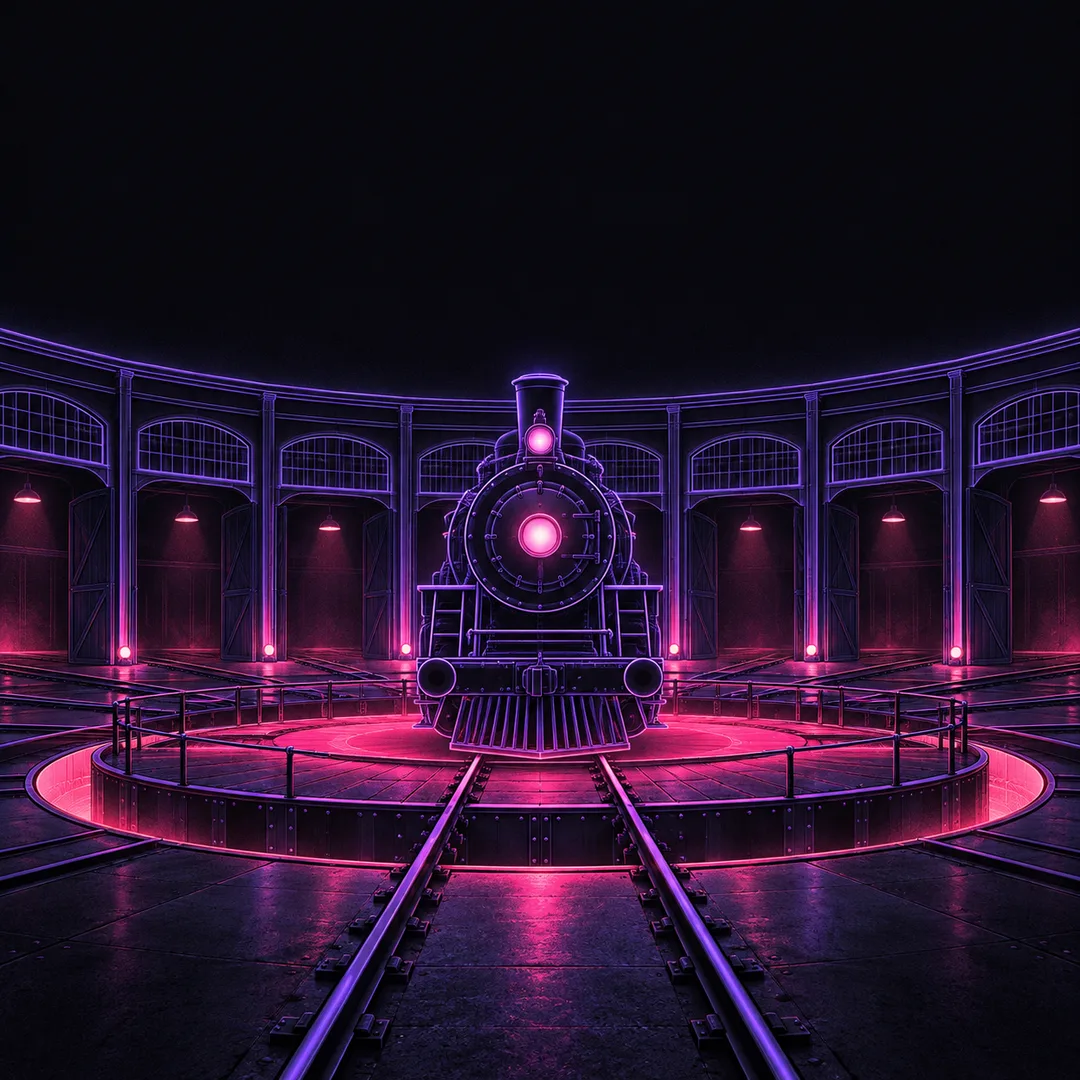
It was a short career. According to the listing, by the 1860s the engines had become too long to be turned and stored there. The Guardian put it more bluntly in 2006: within ten years, new locomotives arrived that were simply too long to fit in the building.
The gin years
So the railway let it go. W & A Gilbey, the gin and wine company, leased the Roundhouse as a liquor store, and it stayed one for roughly the next fifty years. Gilbey's probably added the wooden gallery that still runs around the inside, and it blacked out the skylights to protect the stock. That darkness would last until the 2000s. The building was first listed on 10 June 1954 and is now Grade II*.
Centre 42 and an all-night rave
Its second life began with a playwright. In 1964, Arnold Wesker's Centre 42, an arts project named after Resolution 42 of the 1960 Trades Union Congress, moved into the empty shed. BBC Arts says the building had passed to the businessman Louis Mintz, who let Wesker use it as a base. The dream was a permanent cultural centre with a theatre, a cinema, a gallery and workshops. The money never fully arrived, and Wesker formally dissolved Centre 42 in 1970.
By then the Roundhouse had already found its audience. On 15 October 1966, the underground paper International Times launched there with an all-night rave featuring Soft Machine and Pink Floyd; the Guardian says Pink Floyd played the first gig in the building. On New Year's Eve that year, The Who headlined an event called Psychedelicamania. In July 1967 the building hosted the Dialectics of Liberation congress, with R.D. Laing, Allen Ginsberg and Stokely Carmichael, which BBC Arts has called "the New Left's Woodstock".
“a building that reeked, sometimes literally, of Zeitgeist”
— Brian Morton, BBC Arts, 2016
Two nights in September 1968
The most famous booking came two years later. On Friday 6 and Saturday 7 September 1968, The Doors and Jefferson Airplane played four shows over two nights and swapped places on the bill: the Doors followed Jefferson Airplane on the Friday and supported them on the Saturday. It was the Doors' first performance outside North America, and one of only two UK appearances by the band with Jim Morrison.
Granada Television filmed the shows for a documentary, The Doors Are Open, broadcast on 4 October 1968. A video fault spoiled the Friday footage, so the film uses Saturday's. It has since been released on VHS, DVD and Blu-ray, so anyone can still watch Morrison's Doors on the Roundhouse stage.
Cream played there in 1968 as well, and the venue's own pages list Jimi Hendrix and Patti Smith among the acts of the 1960s and 70s, with David Bowie, the Rolling Stones and Fleetwood Mac among the names who have stood on the same stage. It was a theatre too: the nude revue Oh! Calcutta! opened there in July 1970.
4 July 1976
Eight years later, punk arrived. On 4 July 1976, the day of the American Bicentennial, the Ramones played their first British concert at the Roundhouse, on a bill headlined by the Flamin' Groovies, with the Stranglers also playing. Marc Bolan was in the audience. So were members of the Damned, who played their own first gig two days later.
The Sex Pistols were in Sheffield that night, with the Clash making their public debut on the same bill. Members of both bands caught the Ramones the following evening instead, at Dingwalls in Camden. The Roundhouse kept its place in the decade's records: Motörhead played there on 20 July 1975, Hawkwind recorded "Silver Machine" there in 1972, and Motörhead recorded What's Words Worth? there in 1978. Mott the Hoople even name-checked the place in their song "Saturday Gigs".
Dark years and a toy-maker
None of it paid the bills. In 1983 the Greater London Council passed the building to Camden Council, plans for a Black Arts Centre came and went, and the Roundhouse closed as a regular venue for lack of funds. It did not go completely silent: the sound-system collective Spiral Tribe held a week-long New Year party there in 1991–92, and the director Richard Stanley shot his film Hardware in the empty shell. By the early 1990s, the Guardian later wrote, it had fallen derelict.
“Until recently, the Roundhouse was in worse shape than most of the rock stars who made it famous.”
— Steve Rose, the Guardian, May 2006
The rescue came from an unlikely direction. In 1996 the building was bought by Torquil Norman, the toy entrepreneur behind Bluebird Toys and Polly Pocket, for £3m according to the Guardian, after he read of a plan to turn it into an architectural museum. The Roundhouse Trust was set up in 1998, with trustees including Bob Geldof, Suggs and Terry Gilliam, and the building reopened for an interim period: the Argentine troupe De La Guarda's Villa Villa had a year-long run there in 1999.
The rebuild
The Roundhouse closed again in 2004 for a rebuild that cost somewhere between £27m (the Guardian's figure) and £30m (the Roundhouse's own). The Guardian reported that 60 per cent of the money came from private sources and the Arts Council provided the rest.
The architects, John McAslan + Partners with the engineers Buro Happold, kept the original ironwork and timber ceiling. They rebuilt the central lantern and reinstated the skylights Gilbey's had blacked out, added a glassy three-storey wing, and set a new steel structure on springs on top of the old brick drum. The undercroft below, once used for ash and cinders, became studios for young people. McAslan told the Guardian the brief had been to keep the place raw:
“The beauty of it is, it's hard to read what's new and what's existing.”
— John McAslan, architect, to the Guardian, 2006
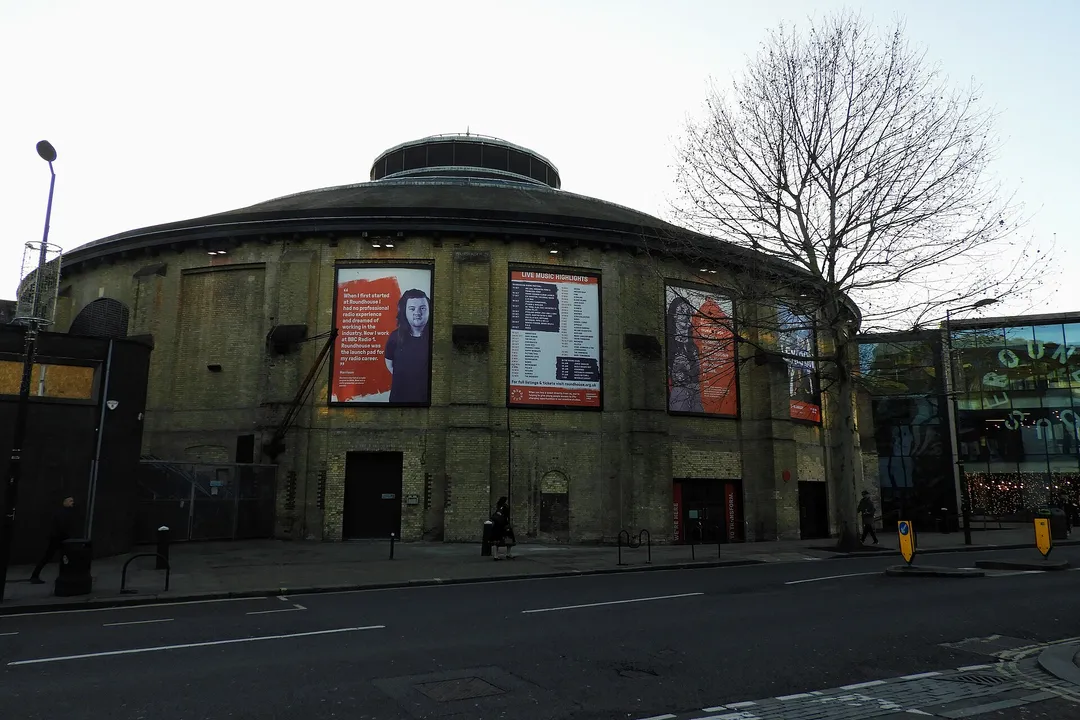
It reopened on 1 June 2006 with Fuerzabruta, the new show from the creators of De La Guarda. That December, George Michael played a free concert there for NHS nurses. Norman stepped down as chair in 2007, was knighted the same year, and died on 19 March 2025.
The Roundhouse now
From 2009 to 2016 the Roundhouse was home to the iTunes Festival, renamed the Apple Music Festival in 2015; live releases recorded there include sets by Adele, Ed Sheeran and Lady Gaga. Bob Dylan played it in April 2009, and it has hosted the BBC Electric Proms and the Royal Shakespeare Company's Histories cycle.
It is also a charity. The Roundhouse says it has worked with 100,000 young people since it reopened, now more than 10,000 a year, and that its annual audiences top 400,000. Daniel Kaluuya, Little Simz and the writer Jack Rooke came through its programmes.
“All of my earliest work began at the Roundhouse, since I was a year 11 student taking two tubes and a bus to get there.”
— Jack Rooke, January 2026
Going to a gig at the Roundhouse
Capacity for gigs is 3,300 standing, or 1,700 when the room is all-seated. The building is on Chalk Farm Road, NW1, and the nearest Tube station is Chalk Farm on the Edgware branch of the Northern line.
The one piece of advice in the Guardian's gig-venue guide is still the right one:
“you want to be inside the ring of columns that support the roof: it makes the difference between feeling you've been watching a gig and taking part in a gig.”
— The Guardian gig venue guide, 2014
Those are the same 24 columns that once stood between the spurs of a locomotive turntable. The engines outgrew the room within a generation. The music has been fitting in since 1966.
Going to the Roundhouse?
Find the people going to the same night, and keep every gig in your diary.
Join OutTwo freeSources
- Building, dates, designer, columns, Gilbey's lease and listing: Historic England list entry 1258103 (text via British Listed Buildings) and Wikipedia, “Roundhouse (venue)”, read 10 Oct 2026
- Stephenson, the gin years, the purchase, the rebuild, McAslan and the 2006 reopening: the Guardian, 29 May 2006
- Capacity, the Trust and the columns: the Guardian gig venue guide, 9 Sep 2014
- Louis Mintz, the 1966 launch, Dialectics of Liberation, Cream and the "Zeitgeist" line: BBC Arts, 21 Oct 2016
- Centre 42: Wikipedia, “Arnold Wesker”; the Doors: “The Doors Are Open” and “The Doors”; the Ramones: “Ramones”; the iTunes Festival: “Apple Music Festival”
- Young people, audiences and Jack Rooke: Roundhouse, 29 Jan 2026; Sir Torquil Norman: Roundhouse, Nov 2025 and Wikipedia, “Torquil Norman”; the £30m figure and acts on the stage: Roundhouse venue hire