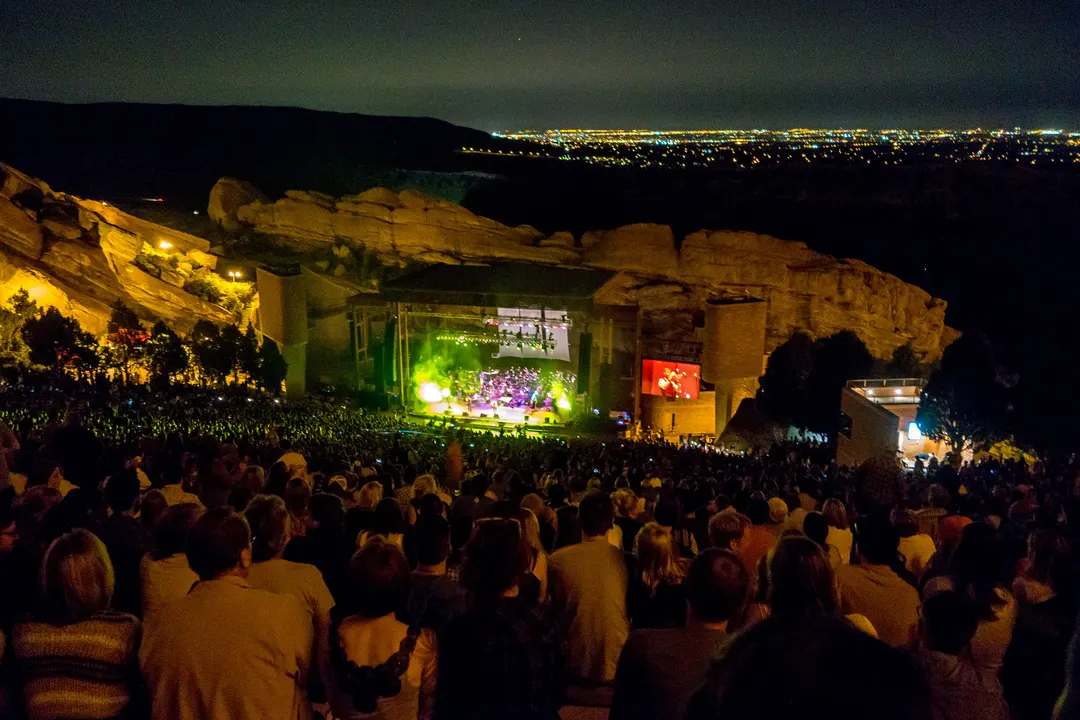
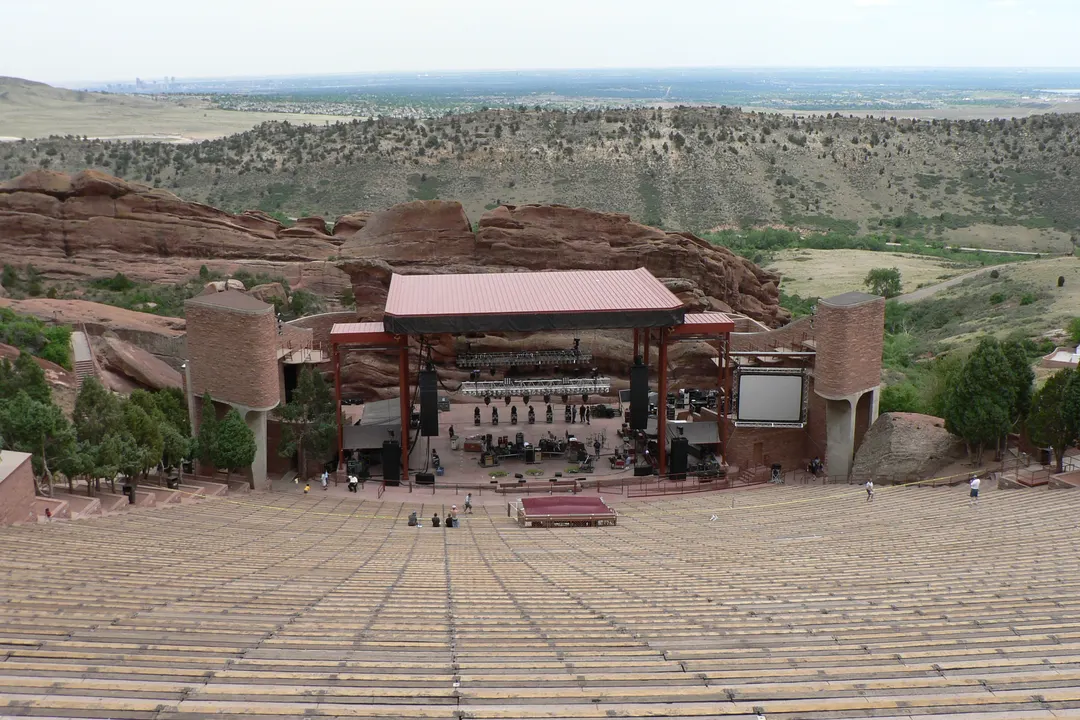
Most venues are built and then become famous. Red Rocks was spectacular long before anyone played a note there. Near Morrison, Colorado, about ten miles south-west of Denver, two enormous sandstone monoliths lean towards each other, and between them sits one of the most celebrated stages in the world.
The rocks
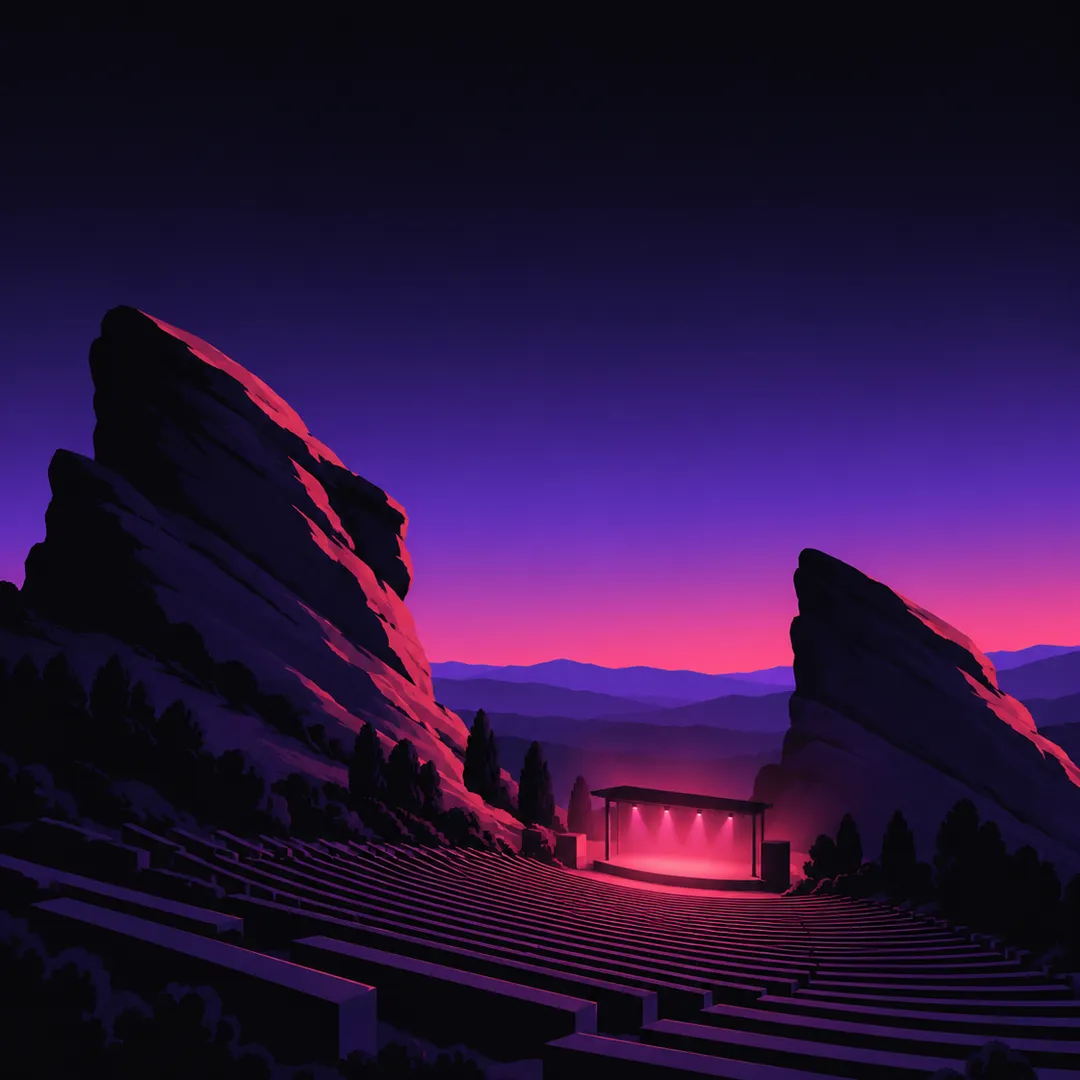
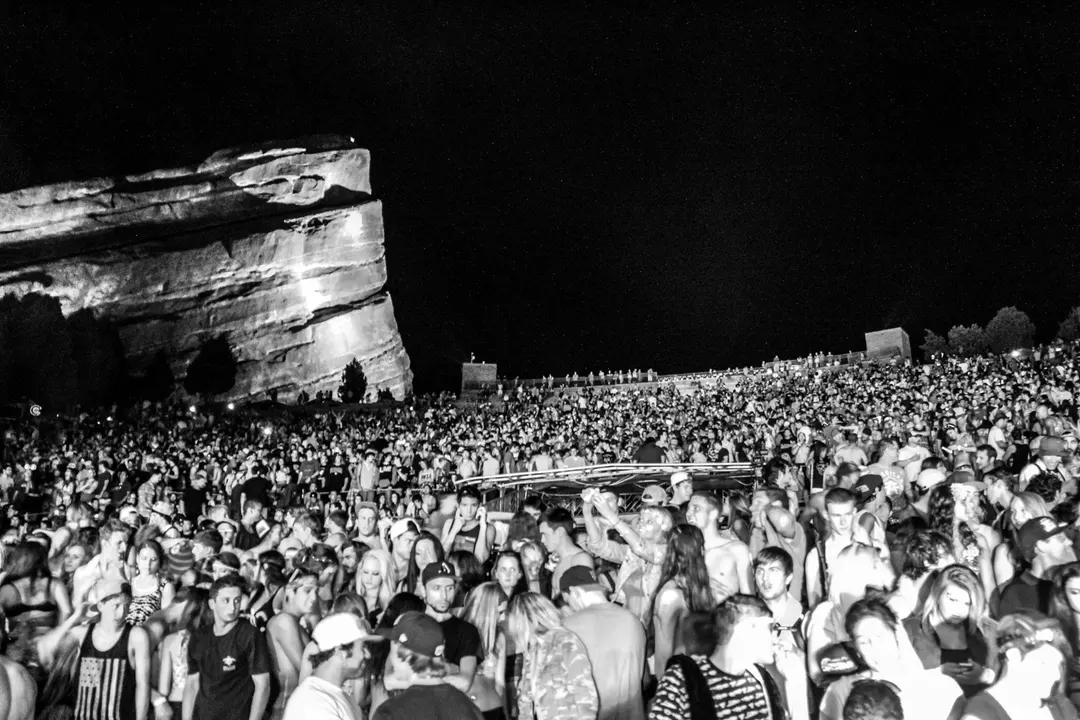
The amphitheatre sits between Ship Rock to the south and Creation Rock to the north, with the smaller Stage Rock to the east. They are part of the Fountain Formation, sandstone laid down roughly 300 million years ago and later tilted upwards when the Rocky Mountains rose. Their colour comes from iron in the rock, which oxidises as it weathers and turns the stone reddish-pink. The stage stands at about 6,450 feet above sea level.
Its sound became part of the legend early. In 1911, the opera singer Mary Garden sang there on a makeshift platform and said:
“Never in any opera house, the world over, have I found more perfect acoustic properties. Never under any roof have I sung with greater ease or had a greater delight in singing.”
— Mary Garden, 1911
From a brass band to a public park
The site was known as the Garden of the Angels in the 1870s and became a park in 1878. In the early 1900s, John Brisben Walker, who had made a fortune selling Cosmopolitan magazine to William Randolph Hearst, began buying up the land and spent $150,000 creating an amusement park he called the Garden of the Titans. Its grand opening, on 31 May 1906, featured Pietro Satriano and his 25-piece brass band: the first concert at Red Rocks.
In 1927 the city of Denver bought the land. Denver still owns and runs the venue today, as part of its mountain parks.
Built by hand
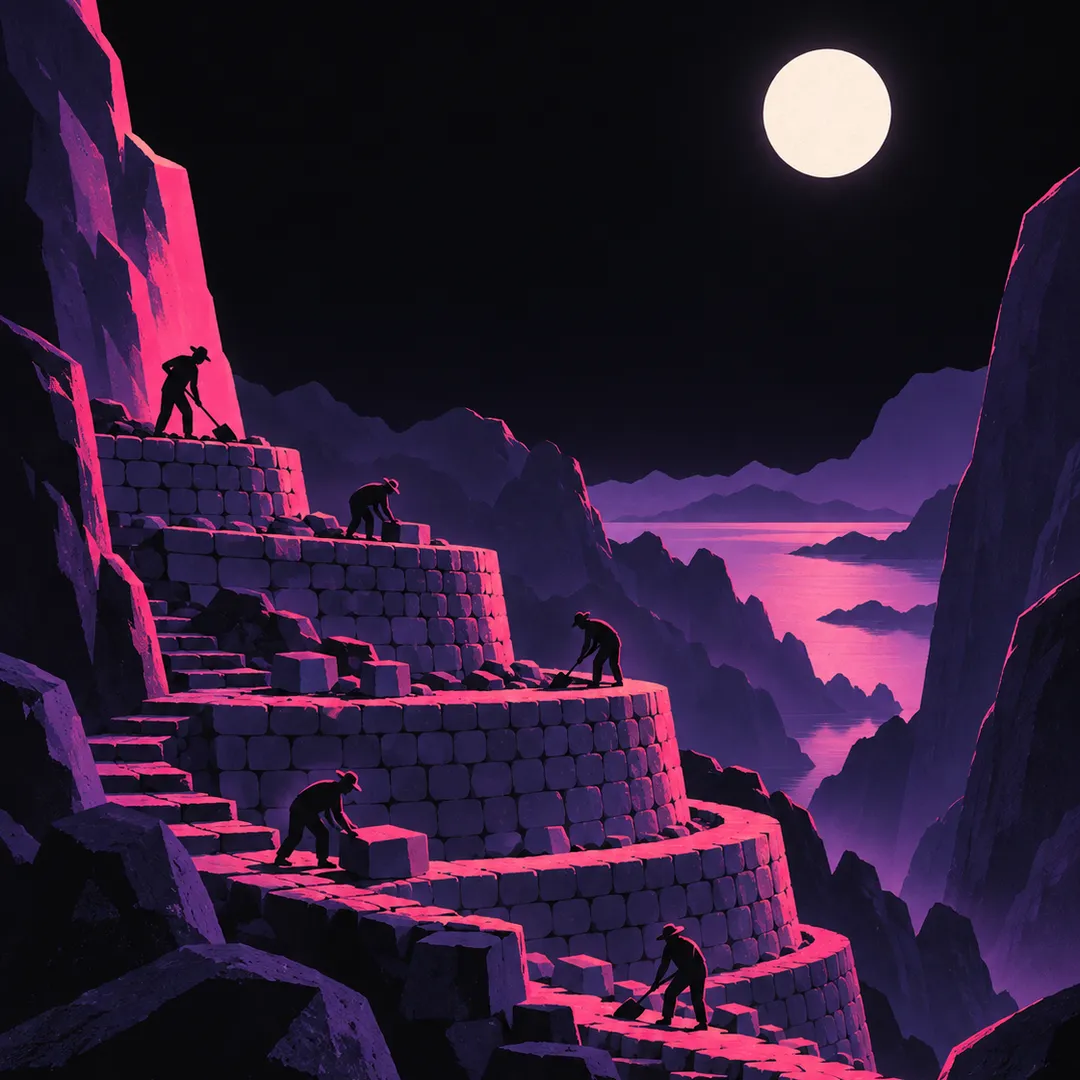
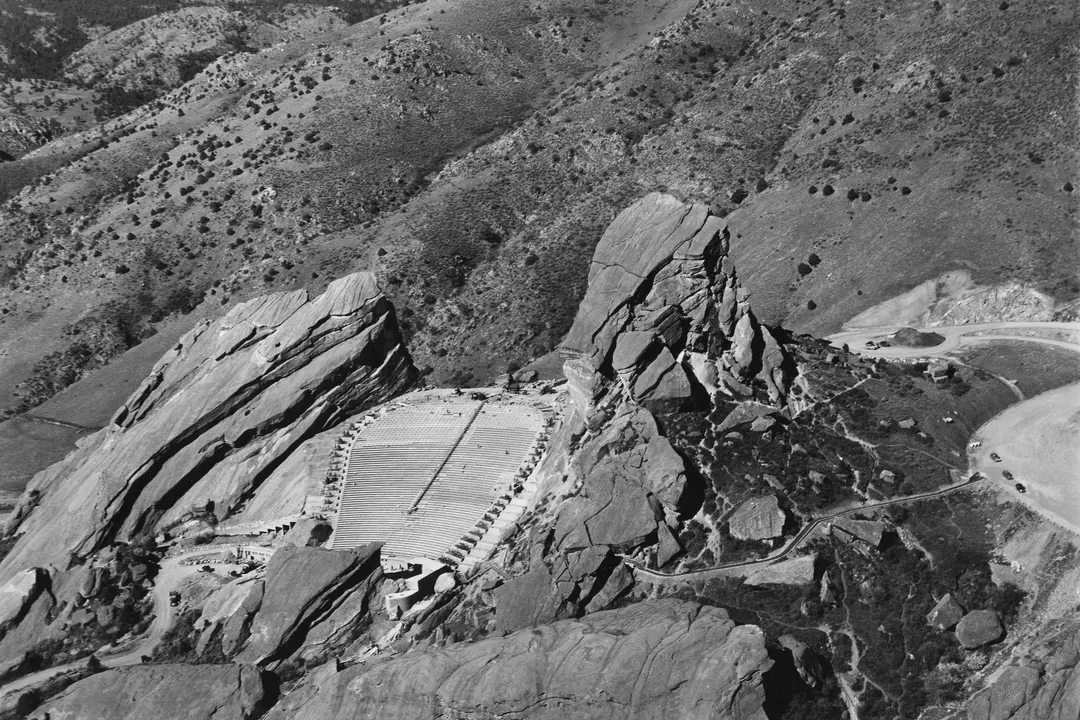
The amphitheatre as it stands today was a Depression-era public works project. In 1936, Denver got federal approval to use the Civilian Conservation Corps, and young CCC workers removed tens of thousands of cubic feet of earth and rock, then laid sandstone quarried in Lyons, Colorado. The architect was Burnham Hoyt, and the job, planned to take two years, took five.
The numbers on the venue's own history page show the scale of it: 50,000 cubic feet of dirt and rock removed, more than 90,000 square feet of sandstone laid, 800 tons of quarried stone and 30,000 pounds of reinforced steel. The materials cost $115,881.87; the labour, $357,281.69. Hoyt's design, the venue says, is the master work of Colorado's most highly regarded architect.
Red Rocks officially opened on 15 June 1941, broadcast nationally by CBS. It seats 9,525 people on long wooden benches; there are 193 steps from the stage to the top plaza, which rises about 100 feet above it.
The nights that made it
- The first Easter Sunrise Service, now the venue's oldest annual event.
- The Beatles play, with tickets at $6.60. Only about three-quarters of the seats sell, making it the only show on their first American tour that didn't sell out. Ringo later remembered the thin air, and being given oxygen.
- Johnny Cash plays the first country show at Red Rocks.
- Jimi Hendrix plays his only Red Rocks show. No recordings or photos of it are known to exist.
- Jethro Tull: people without tickets crash the gates, police respond with tear gas, and Denver bans rock concerts at Red Rocks for five years.
- John Denver becomes the first artist to play four nights in a row.
- Bruce Springsteen makes his Red Rocks debut: "Nice place you got here... bunch of big rocks!"
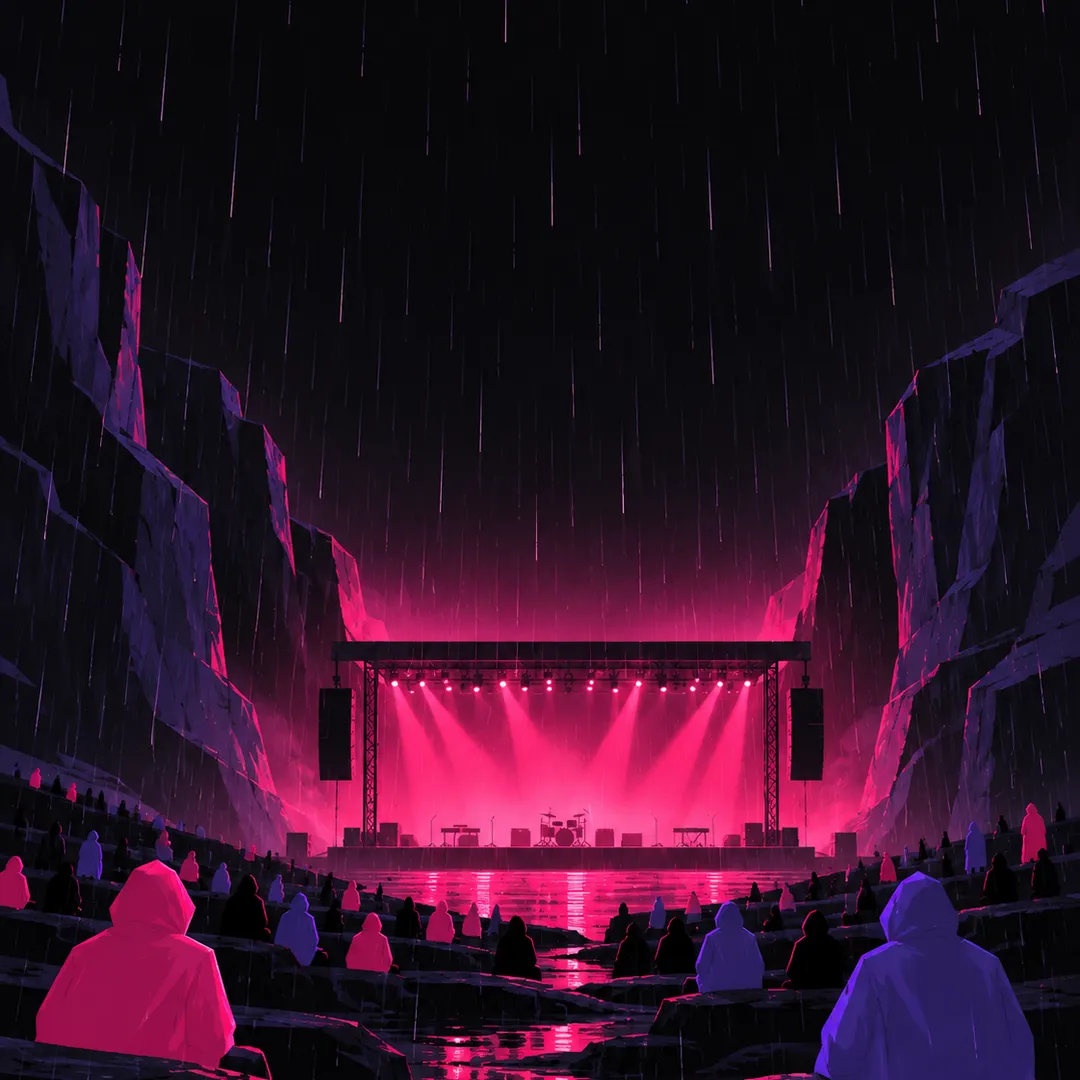
- U2 film Under a Blood Red Sky in driving wind and rain. The show had sold out, but only about 4,400 people braved the weather.
- Blues Traveler begin their Fourth of July tradition at Red Rocks.
Hendrix's 1968 show was also the first Red Rocks booking for promoter Barry Fey, who would shape rock concerts in Denver for decades. Springsteen's 1978 debut was his first outdoor performance anywhere.
U2's night became the most famous of all. The producers spent $40,000 lighting the rocks, the storm turned it into something nobody could have planned, and Rolling Stone later named its performance of "Sunday Bloody Sunday" one of the 50 moments that changed the history of rock and roll.
The record holders
Red Rocks has a way of becoming some bands' second home. Widespread Panic passed every other act in 2008 with 32 sold-out shows; Denver declared 27 June 2008 Widespread Panic Day, and their June 2026 run took them to 78 consecutive sell-outs. Dave Matthews Band released Live at Red Rocks 8.15.95, the first in a series of official live recordings. Blues Traveler have played there almost every Fourth of July since 1993, missing 1999 only because singer John Popper needed heart surgery. Live recordings made there range from the Moody Blues' A Night at Red Rocks to Neil Young, Incubus and Depeche Mode. Mumford & Sons filmed The Road to Red Rocks there in 2012, and in 2019 Diana Ross returned 50 years after her first performance at the venue with the Supremes.
It also became a cinema: Film on the Rocks began on 7 August 2000 with a screening of Casablanca, accompanied by a local band.
And it is still a place of worship once a year. At the first Easter Sunrise Service, in 1947, an estimated 60,000 people turned up; 16,000 squeezed into the amphitheatre. Not every night is gentle, though: in June 2023, a hailstorm before a Louis Tomlinson show injured more than 90 people, seven of whom were taken to hospital.
Visiting Red Rocks
Red Rocks sits inside a 738-acre park owned by the city of Denver, about ten miles south-west of the city. The park and its visitor centre are free to visit on days without shows, and the Trading Post, a two-storey Pueblo Revival building, has stood on the site since 1931; a $26.4 million visitor centre opened in 2003. The stage got a new roof in 2021.
Every seat is a wooden bench: about 2.5 miles of them, according to the venue. Wheelchair seating is in rows 1 and 70. It is 193 steps from the stage to the top plaza, and the stage sits at about 6,450 feet, so bring water and take the climb slowly; the air really is thinner, as Ringo found out.
A landmark that still sells out
Red Rocks Park was added to the National Register of Historic Places in 1990, and in 2015 the park and its Civilian Conservation Corps camp were designated a National Historic Landmark. The venue was inducted into the Colorado Music Hall of Fame in its first class, in 2011.
It is still among the busiest stages anywhere: in 2025, more than 1.7 million paying fans came to 236 events, and Pollstar named it the best-attended amphitheatre of the year. The season runs from March to November, and the park itself is free to visit, so you can climb those 193 steps on a day with no show at all.
Seeing a show at Red Rocks?
Find the people going to the same night, and keep every gig in your diary.
Join OutTwo freeSources
- Location, rocks, capacity, history and famous performances: Wikipedia, “Red Rocks Amphitheatre” and “Red Rocks Park”, read 7 Oct 2026
- History, construction, fast facts, geology and notable performances: the venue's own pages, History, Geology, Notable Performances
- Mary Garden's 1911 quote and the Hall of Fame induction: Colorado Music Hall of Fame
- National Historic Landmark (2015): Denver Mountain Parks Foundation; 2025 attendance: Denver Arts & Venues (29 Dec 2025); Widespread Panic's 2026 run: Visit Denver
- Blues Traveler's 1999 absence and the list of live recordings: Wikipedia, “Red Rocks Amphitheatre”
- Construction figures, the Trading Post, visitor centre, seating, steps and the 2021 roof: the venue's History and FAQ pages; the 2023 hailstorm: Wikipedia, citing Deadline, CNN and the Denver Gazette
- U2's 1983 show and the Rolling Stone ranking: Wikipedia, “U2 Live at Red Rocks: Under a Blood Red Sky”