Coldplay's eighth tour began at the Estadio Nacional in San José, Costa Rica, on 18 March 2022. Three and a half years and 225 dates later, it paused at Wembley Stadium in London on 12 September 2025, with the band expecting to start again in 2027. In between, it sold 13.1 million tickets, more than any tour in history. These are the numbers behind it, all from the published record.
The tour they almost didn't do
The tour exists partly because of one Coldplay didn't play. When the band released Everyday Life in 2019, Chris Martin told the BBC they wouldn't tour it until they could make their shows more sustainable. Instead they promoted that album with a few small charity events and a performance from the Amman Citadel in Jordan, broadcast on YouTube, and hired a team of sustainability experts to work out how to cut the footprint of a stadium tour.
The new tour was announced on 14 October 2021, the day before the album Music of the Spheres came out, with a plan covering 12 areas and a target of halving emissions compared with their previous tour, A Head Full of Dreams. It became the band's return to live shows after the pandemic, and later took in the 2024 album Moon Music too. The first stop was Costa Rica, chosen because of the country's renewable energy.
How the show worked
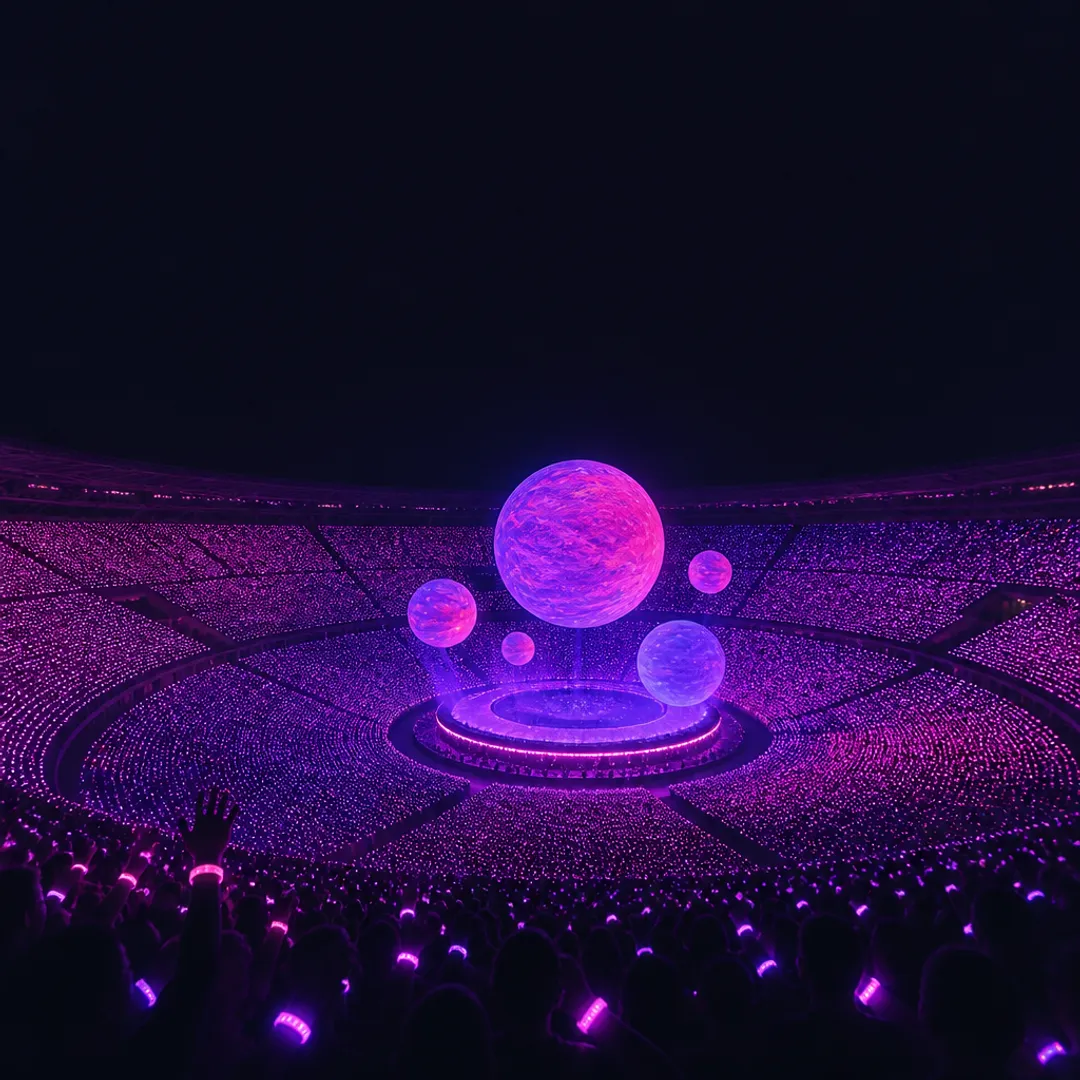
The stage was designed by Misty Buckley with lighting designer Sooner Routhier: three round stages joined by runways, two 14-metre circular screens, four inflatable LED spheres, and an arched video wall 44 metres wide called the Moonrise. The light-up wristbands handed to the crowd were made from sugarcane, and collected after the show to be cleaned and used again.
The show ran for more than two hours in four acts, called Planets, Moons, Stars and Home. Fans near the stage were asked to turn around during “Yellow” and sing it to the people at the back; during “A Sky Full of Stars” Martin stopped the song and asked everyone to put their phones away before starting again. It ended with the words “Believe in love” on the screen. In many cities the band played a local song too, including “Sen o Warszawie” in Warsaw in 2022 and “Sit Down” in Manchester in 2023.
Greener on the road
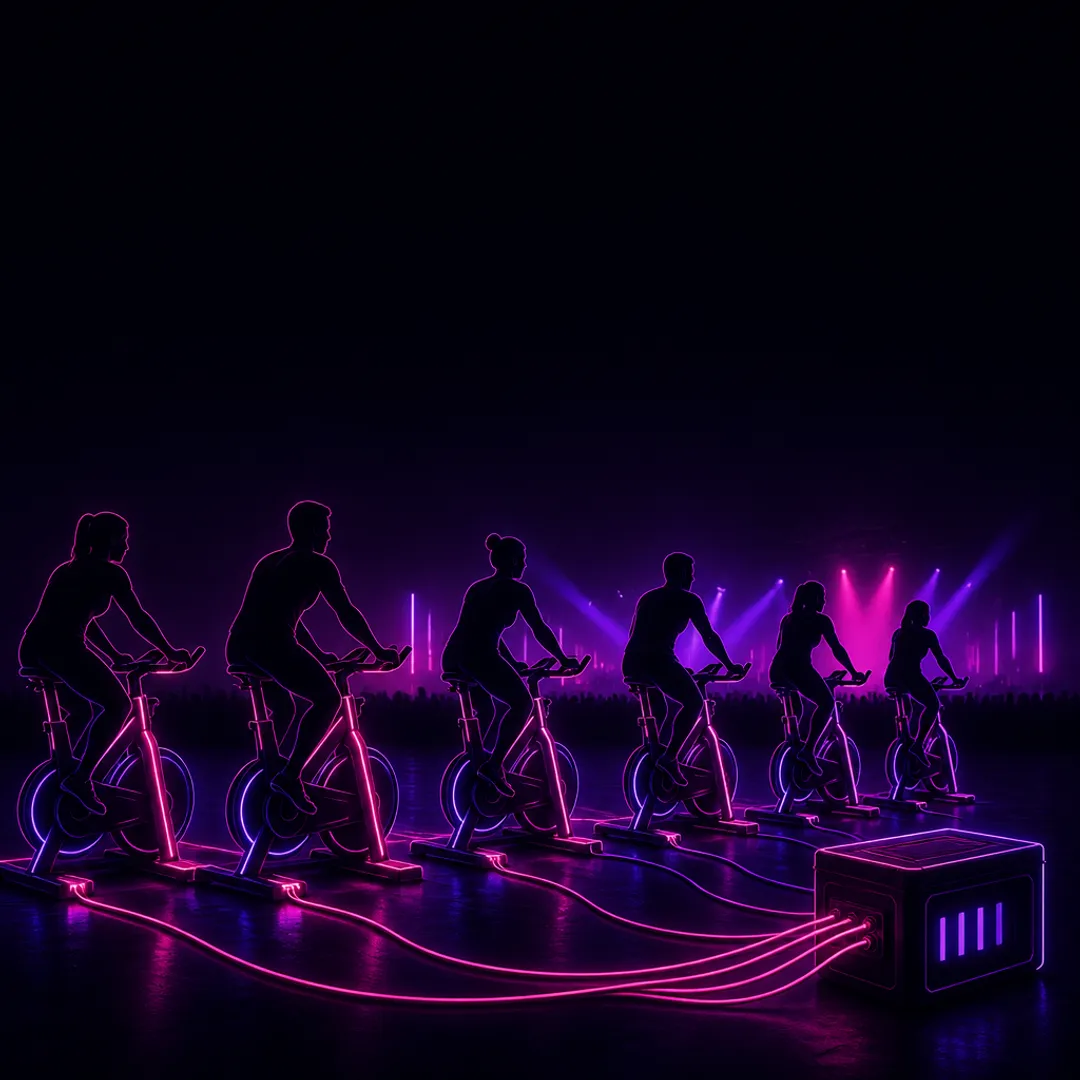
With BMW, the band built what the tour describes as the world's first rechargeable mobile show battery, powered by wind turbines, solar blankets laid on empty seats and vegetable-oil fuel. Fans could join in too, on two kinetic dance floors and at least 15 exercise bikes. The crew travelled in around 30 trucks and 10 buses, using electric vehicles or biofuel where they could, and one tree was planted for every ticket sold, 9 million of them in all.
According to the tour's figures, with progress monitored by a team at MIT, emissions in the first two years were 59% lower than on their previous tour. The 2025 Wembley residency became the first to run completely on solar, wind and kinetic power. The tour also offered Infinity Tickets: $20 seats for fans who couldn't afford standard prices, sold in pairs and allocated at random on the day.
Year by year
Billboard named Coldplay its top touring group in every year of the run: $342.1 million from 3.8 million tickets in 2022, $342.5 million from 3.2 million in 2023, $400.9 million from 3 million in 2024, and $464.4 million from 3.5 million in 2025. The busiest year for shows was the first, with 65 dates across Latin America, North America and Europe.
The records
The final figures, from 223 reported shows, are $1.52 billion and 13.1 million tickets. That makes it the most-attended tour of all time and the first tour by a band to gross $1 billion. In Europe and Latin America it took more money and drew bigger crowds than any tour before it.
Along the way, Coldplay played 10 nights at the Estadio River Plate in Buenos Aires, taking $49.7 million from 626,841 tickets, the biggest gross and attendance in South American boxscore history. They played six nights at the Morumbi in São Paulo, six in Singapore and four at the Stade de France. The second European run sold 1.4 million tickets in a single day, the fastest for a band at the time, while more than 812,000 people queued online for the UK dates.
And fans without tickets came anyway. Reports from several cities described crowds gathering outside the stadiums to listen, including 34,000 people in Munich.
The queues
Demand was enormous almost everywhere the tour went. When the second European run went on sale, news outlets counted 450,000 people queuing online in Portugal, 350,000 in Spain and 700,000 each in Italy and the Netherlands. In Asia, demand topped 1.7 million people in Indonesia, 400,000 in Malaysia and a million in Singapore, where the band added dates for a six-night run. The Philippines' ticket seller had to suspend online sales when its servers crashed, and in Taiwan the first show sold out in three minutes.
Later legs were the same. 13 million people joined the online queue for the shows in India, 600,000 for Vienna, 500,000 for Hong Kong and more than 200,000 for Auckland. The single show at Gelora Bung Karno Stadium in Jakarta on 15 November 2023 took $13.9 million, the most for one concert in Southeast Asia. Coldplay also set records for the most consecutive shows at stadiums including Helsinki's Olympic Stadium and Vienna's Ernst-Happel-Stadion (four each) and Eden Park in Auckland (three).
What it left behind
The tour changed more than the record books. In Portugal, Italy and Malaysia the demand led to sharp rises in ticket touting, and investigations into it prompted new laws. Indonesia simplified its permit process for big events after Coldplay couldn't add more dates there. Live Nation adopted the band's methods to offer greener options to other artists, and Time named Coldplay among the most influential leaders on climate action. A concert film, Music of the Spheres: Live at River Plate, filmed at the Buenos Aires shows, was released in cinemas around the world in 2023.
Sixteen nights at Wembley
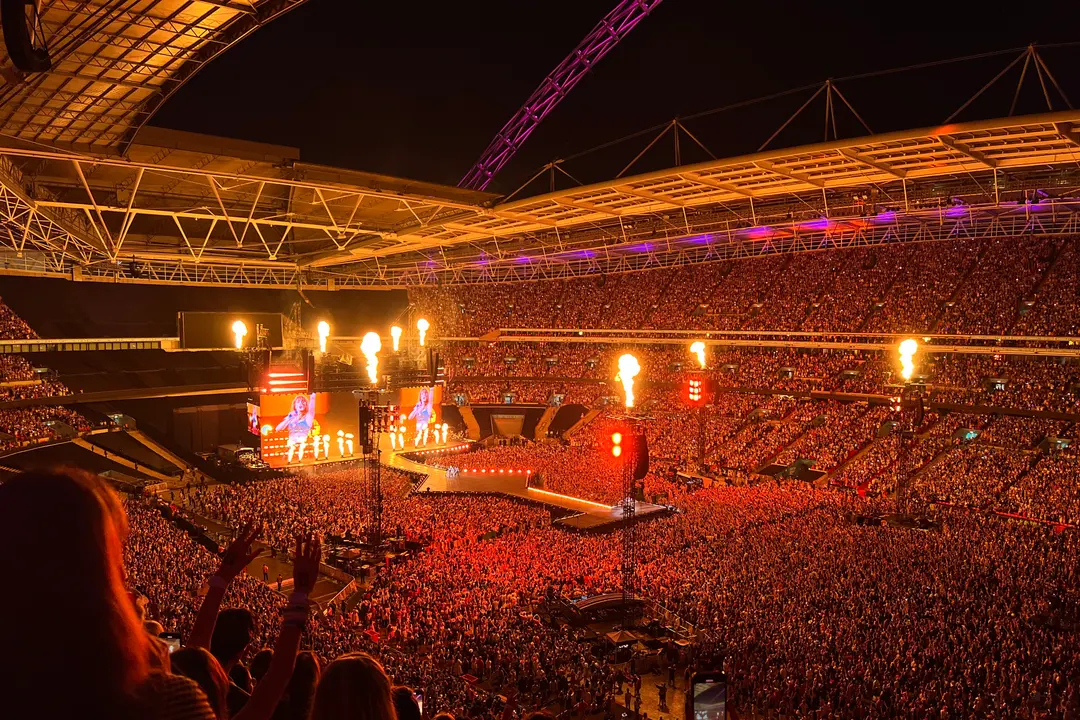
London got more of the tour than anywhere else. Coldplay played six nights at Wembley Stadium in August 2022, then came back for ten more between August and September 2025, the first act to stage ten concerts at the stadium in a single year. Those 16 shows on one tour are a Wembley record, and they take the band's total there to 22, more than anyone. The last of them, on 12 September 2025, is where the tour paused.
The tour at a glance
- Tour announced, a day before Music of the Spheres is released.
- Opening night at the Estadio Nacional, San José, Costa Rica.
- 65 shows, including six at Wembley in August and 10 at River Plate in Buenos Aires.
- 58 shows: Brazil, Europe and Asia, including six nights at the Morumbi in São Paulo.
- 54 shows. Moon Music is released.
- 48 shows, ending with a ten-night Wembley residency.
- The tour pauses at Wembley Stadium, with a restart expected in 2027.
How it compares
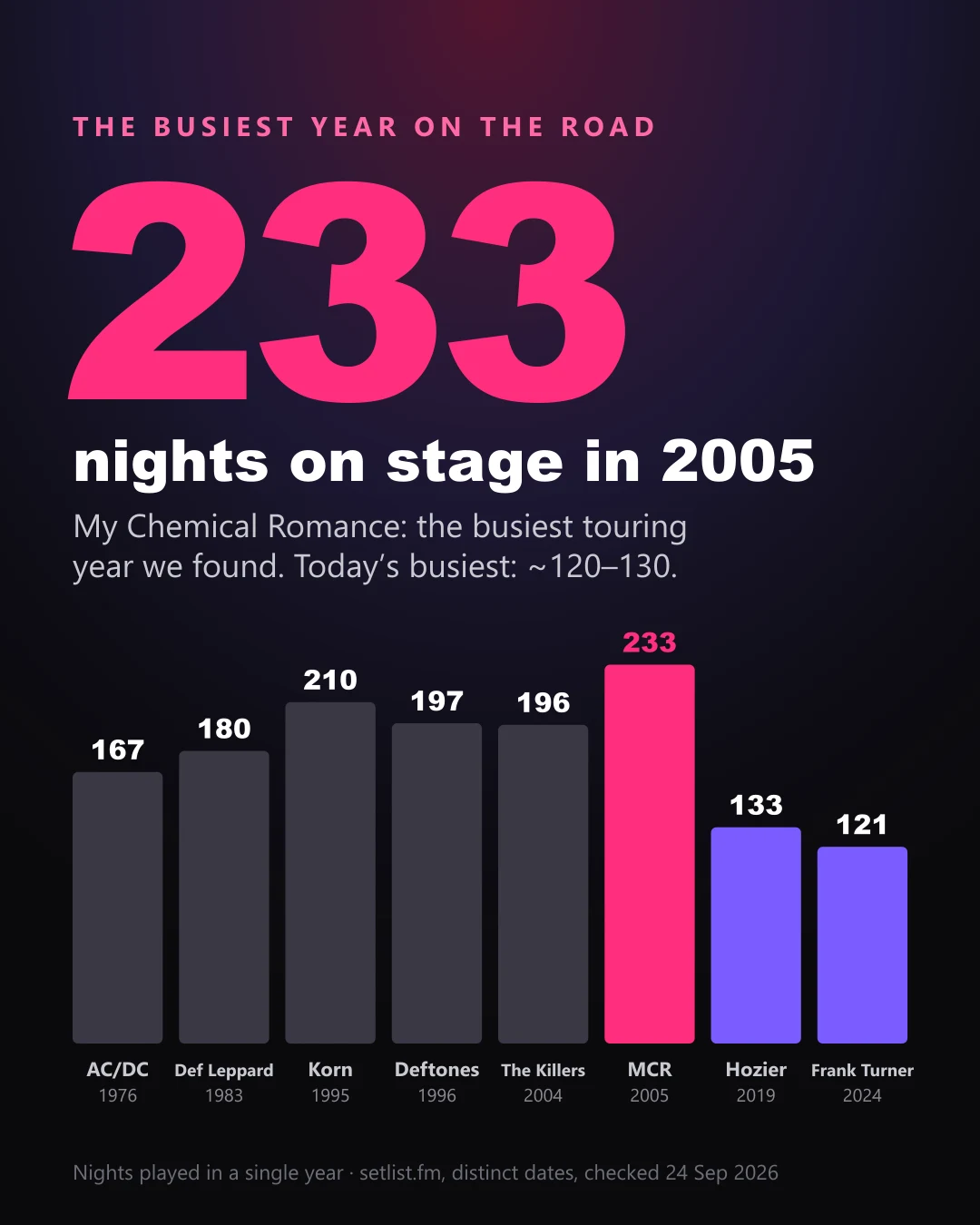
The tour's nearest rival is the Eras Tour: Taylor Swift's 149 shows grossed more, by her company's figures, but Coldplay sold more tickets over a longer run. And for a sense of scale on the road, compare the busiest touring years of the 2000s, when some bands played more than 200 nights a year. Coldplay's busiest year here had 65, nearly all of them in stadiums. For another big return to the stadiums, see the Oasis reunion in numbers, and for the other billion-dollar stadium run of these years, The Weeknd's After Hours til Dawn tour. And for the stadium where the tour paused, read our story on Wembley.
A note on the figures: grosses and ticket counts are the published totals reported to Billboard and Pollstar, as collected on Wikipedia, and the emissions figure is the band's own, measured with the MIT team. Show counts per year are our count from the tour's published date lists.
Were you there?
Log the Coldplay nights you've been to in your OutTwo gig diary, keep the setlist, and find people going when the tour comes back.
Join OutTwo freeSources
- Dates, shows, production, sustainability, grosses and records: Wikipedia, “Music of the Spheres World Tour”, read 23 Oct 2026 (figures from Billboard and Pollstar)
- Wembley record: Wikipedia, “Wembley Stadium”, read 23 Oct 2026