Glastonbury Festival began on a single day in September 1970, on a dairy farm in Somerset, for 1,500 people. More than half a century later it is a five-day city in a field, licensed for up to 210,000 people including staff and performers, and its tickets sell out before anyone knows who is playing. This is how it got there: the farmer and his overdraft, the three pyramids, the years the field was left to rest, and every act that has closed the Pyramid Stage.
A dairy farmer's overdraft
Michael Eavis took over Worthy Farm, between the villages of Pilton and Pylle and six miles east of Glastonbury, when he was 19, after his father died. In 1970 he went to the Bath Festival of Blues and Progressive Music and watched an open-air set headlined by Led Zeppelin. It was, he later told the BBC, "the peak of the flower power era, really." He decided to put on his own.
“I think this is the quickest way of clearing my overdraft.”
— Michael Eavis, to the BBC in September 1970
He booked The Kinks to headline for £500. They pulled out after a newspaper called the event a "mini festival", and the agent offered Marc Bolan's Tyrannosaurus Rex instead, who were on their way to a Butlins in Minehead. The Pop, Blues & Folk Festival took place on Saturday 19 September 1970. Tickets were £1, including free milk from the farm, and 1,500 people came. Stackridge, by one account, ended up as both the opening and the closing act after the scheduled opener failed to turn up.
It lost money. Eavis paid Bolan in £100 instalments from his milk profits for five months. "I didn't make a profit until 11 years later," he told the BBC.
The first pyramid, and a free festival
In 1971 the event moved to the summer solstice and became the Glastonbury Fair. Andrew Kerr and Arabella Churchill planned it, and entry was free, paid for by supporters. Hawkwind, Traffic, Melanie, Fairport Convention and David Bowie played to around 12,000 people, and the festival was filmed as Glastonbury Fayre.
It also gave Glastonbury its symbol. The theatre designer Bill Harkin built the first pyramid stage from scaffolding, expanded metal and plastic sheeting. Then the field went quiet for most of the decade: a small impromptu gathering of about 500 people in 1978, and a three-day Glastonbury Fayre in 1979 for the Year of the Child, which drew 12,000 people at £5 and made a huge loss.
Three pyramids
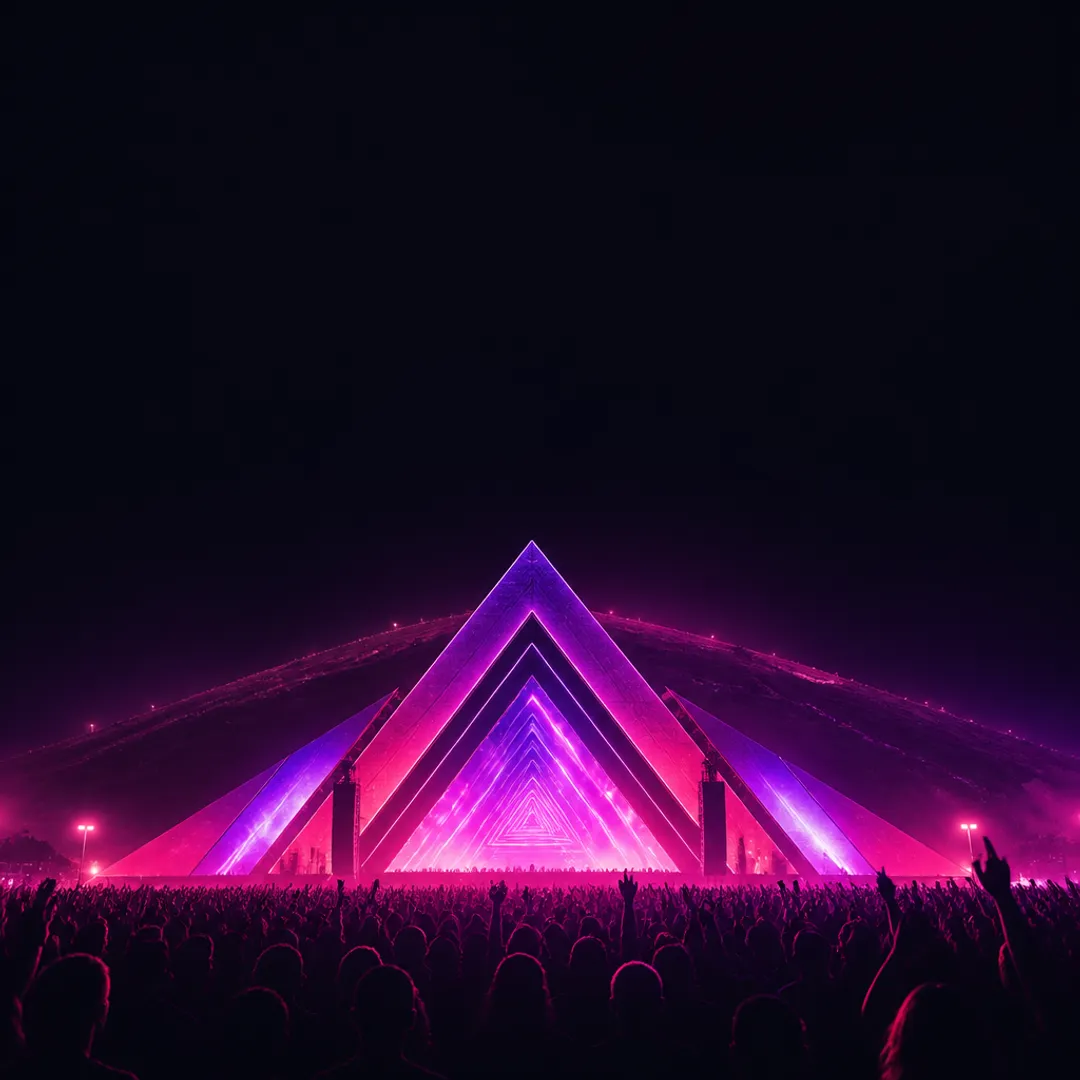
When the festival returned in 1981, now called Glastonbury Festival, it got a permanent pyramid, built from telegraph poles and ex-Ministry of Defence metal sheeting. It took two months to build and spent the rest of the year as a cowshed and animal food store. That pyramid burned down on 13 June 1994, days before the festival, and a local stage company built a replacement in time.
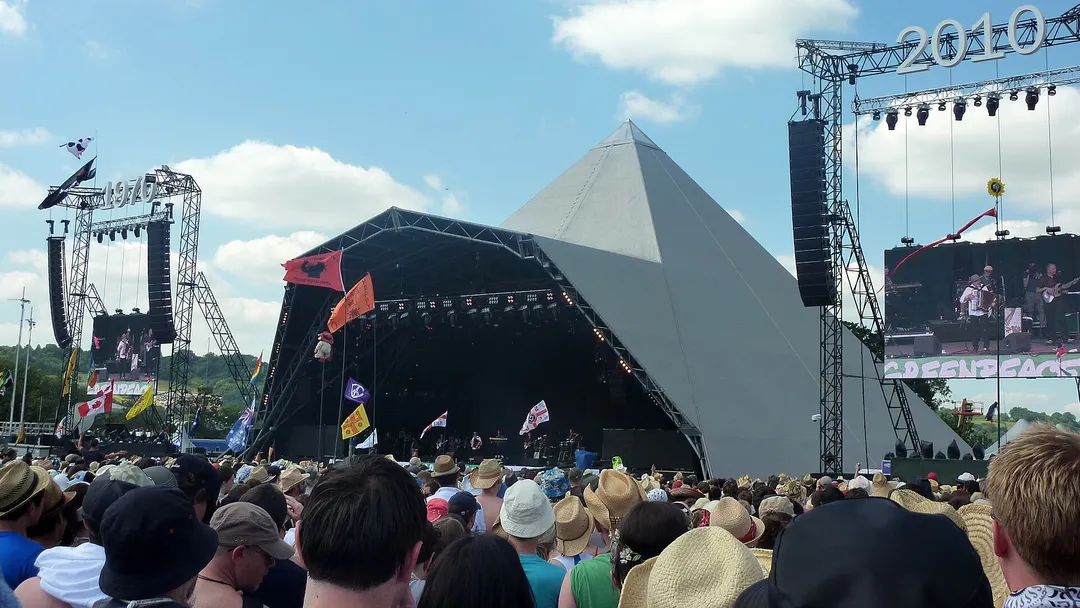
The third and current Pyramid Stage arrived in 2000. Built by Pilton villager Bill Burroughs to designs based on the Great Pyramid of Giza, it is steel, covers 40 metres by 40 metres, uses 4km of steel tubing and weighs over 40 tonnes. The festival itself calls it "the most instantly recognised festival stage in the world".
From CND to Oxfam, Greenpeace and WaterAid
1981 was also the first CND festival, and the first year Glastonbury made a profit. Eavis handed about £20,000 to CND that year. After the Cold War ended, he felt public concern had moved from nuclear war to the environment, and in 1992 the donations switched to Greenpeace and Oxfam; WaterAid joined them later. Oxfam now organises around 2,000 volunteer stewards. In 2025 the festival reported payments of more than £4.2 million to more than 300 organisations.
How it got so big
Growth came quickly once the festival was licensed. The council's first licence, in 1983, set a crowd limit of 30,000. Channel 4 broadcast it live in 1994, the BBC took over in 1997, and attendance passed 100,000 for the first time in 1998. In 2000 around 250,000 people were estimated on site although only 100,000 tickets had been sold, and the council refused further licences until that was solved. A new "superfence" in 2002 brought numbers back under control, and in 2007 buyers had to pre-register with a passport photo for the first time.
Every Pyramid Stage headliner since 1992
The table below shows the act at the top of each day's Pyramid Stage bill, as listed by Wikipedia's line-up records. Years with no festival are left out. Where an act pulled out, the replacement is shown: Gorillaz stepped in for U2 in 2010 after Bono's back injury, Florence and the Machine moved up for Foo Fighters in 2015 after Dave Grohl broke his leg, and Pulp replaced The Stone Roses in 1995.
- Carter the Unstoppable Sex Machine, Shakespears Sister, Youssou N'Dour.
- The Levellers, Elvis Costello & the Attractions, Peter Gabriel.
- Oasis, Pulp, The Cure. Pulp replaced The Stone Roses.
- The Prodigy, Radiohead, Ash.
- Primal Scream, Blur, Pulp.
- R.E.M., Manic Street Preachers, Skunk Anansie.
- The Chemical Brothers, Travis, David Bowie. The new steel pyramid's first year.
- Coldplay, Stereophonics, Rod Stewart. Coldplay replaced The Strokes.
- R.E.M., Radiohead, Moby.
- Oasis, Paul McCartney, Muse.
- The White Stripes, Coldplay, Basement Jaxx.
- Arctic Monkeys, The Killers, The Who.
- Kings of Leon, Jay-Z, The Verve.
- Neil Young, Bruce Springsteen & the E Street Band, Blur.
- Gorillaz, Muse, Stevie Wonder. Gorillaz replaced U2.
- U2, Coldplay, Beyoncé.
- Arctic Monkeys, The Rolling Stones, Mumford & Sons.
- Arcade Fire, Metallica, Kasabian.
- Florence and the Machine, Kanye West, The Who.
- Muse, Adele, Coldplay.
- Radiohead, Foo Fighters, Ed Sheeran.
- Stormzy, The Killers, The Cure.
- Billie Eilish, Paul McCartney, Kendrick Lamar.
- Arctic Monkeys, Guns N' Roses, Elton John.
- Dua Lipa, Coldplay, SZA.
- The 1975, Neil Young and the Chrome Hearts, Olivia Rodrigo.
Before 1992 the records are less tidy. The festival's own histories and Wikipedia name Hawkwind and Ginger Baker as the 1981 headliners, The Smiths among the 1984 bill-toppers, and The Cure in both 1986 and 1990, but the old running orders don't reliably show which act closed which night, so we haven't split them by day.
The firsts, in the sources' own words
Jay-Z, 2008: "the first major hip-hop artist to headline" the festival, after a pre-festival row in the press over a rapper topping the Saturday bill. Beyoncé, 2011: the first woman to headline since Skunk Anansie in 1999. Stormzy, 2019: the first British rapper to headline. Billie Eilish, 2022: the youngest headliner in the festival's history. 2024: the first year two of the three Pyramid headliners were women, Dua Lipa and SZA.
And the record: Coldplay headlined for a fifth time in 2024 (2002, 2005, 2011, 2016 and 2024), the first act to do so. The Cure have headlined four times; Arctic Monkeys, Muse and Radiohead three. The Rolling Stones, remarkably, made their first ever Glastonbury appearance only in 2013, when they headlined on the Saturday.
The years the field rests
Glastonbury doesn't happen every year. Fallow years, as the festival calls them, are meant to come roughly every five years to give the land, the village and the organisers a break, though in practice the pattern has been irregular: 1988, 1991, 1996, 2006, 2012 and 2018 were planned breaks. 2001 is counted as a fallow year by Wikipedia, but at the time the BBC reported that Eavis had cancelled it over safety fears about gatecrashers. 2012 moved from 2011 because of a shortage of portable toilets and police during the London Olympics.
“The fallow year is important because it gives the land a rest.”
— Emily Eavis, to BBC News, June 2025
The cruellest gap was 2020. The festival's 50th anniversary was due on 24 to 28 June 2020, with Paul McCartney, Taylor Swift and Kendrick Lamar announced as headliners. It was cancelled on 18 March 2020 because of COVID-19, and 2021 followed, replaced by a livestream from the farm, Live at Worthy Farm. When the festival returned in 2022, McCartney and Lamar kept their slots and Billie Eilish took Swift's.
2026 is a fallow year, so there is no Glastonbury this year. The festival returns from Wednesday 23 to Sunday 27 June 2027.
Going to Glastonbury: how it works
Register first. Everyone aged 13 and over has to register online in advance, for free, with a passport-style photo. Tickets carry the holder's photo and can't be transferred. For 2027, registration closed on 25 September 2026.
The sale. Tickets are sold only through See Tickets, up to six per transaction, with each person's registration number and postcode. For 2027 a general admission ticket cost £408 including the booking fee, paid as a £100 deposit and the balance in April. Everyone on the page when the sale opens gets a random place in the queue, and the festival asks you not to refresh or use several tabs. The 2027 tickets sold out in 42 minutes on 4 October 2026.
Missed out? Cancelled and returned tickets go back on sale in a resale in spring. For 2027 that is spring 2027.
The site. It runs for five days: gates open on Wednesday morning, the main stages run Friday to Sunday, and everyone leaves by Monday afternoon. By the AP's count the site covers about 1,000 acres inside an 8km fence, and the 2025 festival had nearly 4,000 performers on around 120 stages. Your ticket includes camping (bring your own tent), and single-use plastic bottles haven't been sold on site since 2019, so bring a refillable one. Extra trains run to Castle Cary, with shuttle buses to the site. Our festival packing list covers the rest.
Going in 2027?
Keep every Glastonbury set you see in your OutTwo gig diary, build your line-up, and find people going to the same stages.
Join OutTwo freeSources
- History, attendance, ticket prices, fallow years and line-ups: Wikipedia, “Glastonbury Festival” and “Glastonbury Festival line-ups”, read 19 Oct 2026
- The festival's own history pages (1970–2025), Pyramid Stage page, ticket information and 2025 charity figures
- 1970 and Michael Eavis's quotes: BBC Culture, 23 Jun 2025
- 2026 fallow year and Emily Eavis: BBC News, 26 Jun 2025; 2001: BBC News, 4 Jan 2001; 2012: The Guardian, 17 Oct 2010
- Firsts: Wikipedia's 2008, 2022 and 2024 festival pages and “Stormzy”; site figures: AP, 25 Jun 2025
- 2027 tickets: NME, 8 Sep 2026 and Euronews, 5 Oct 2026